

Why the TIA Policy Forum Matters
August 13, 2026
Telematics, Decoded
September 25, 2026Somewhere on the Road, a Truck is Bringing You Dinner
The Trucking Industry’s Impact, by the Numbers
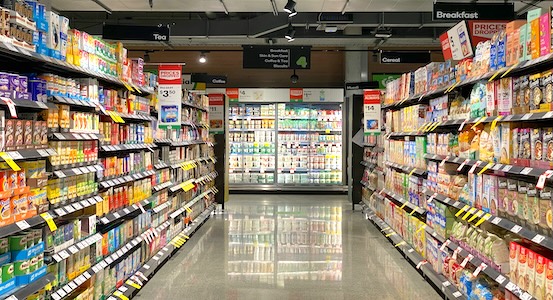
Every shelf in this aisle got stocked by a truck. Some of them more than once a week.
Open the refrigerator. Almost every item inside — the milk, the produce, the packaged goods — made its way to the store on a truck. Before that, the ingredients that became those products also moved by truck, often several times over, from farm to processor to distributor to shelf. Take trucking out of the picture and the shelves empty out within days. That’s not an exaggeration. It’s how tightly the food supply chain depends on trucking.
An industry that measures itself in billions of tons
The scale is hard to overstate. In 2024, commercial trucks generated an estimated $906 billion in gross freight revenue and hauled 11.27 billion tons of freight, roughly 72.7% of everything shipped domestically by weight, according to the American Trucking Associations. Nearly 15 million trucks are registered to do that work, and the fleet logs almost 330 billion miles a year getting it done.
Trucking doesn’t stop at the border, either. It carried 67% of the value of U.S.-Canada surface trade and 85% of U.S.-Mexico trade in 2024, tying North American supply chains together, one load at a time.
Millions of jobs, most of them at small companies
The freight itself is only part of the story. Trucking employs 8.4 million people across the economy, including 3.58 million drivers, and that’s before counting the mechanics, dispatchers, warehouse staff, and freight brokers whose jobs exist because trucks need to move. The Bureau of Transportation Statistics tracks these employment trends across the broader transportation and warehousing sector, and trucking consistently accounts for a large share of it.
Contrary to the image of a handful of national mega-carriers, most of this employment sits with small operators. Almost 580,000 motor carriers are registered with the FMCSA, and 91.5% of them run 10 trucks or fewer. Trucking is, in large part, a small business industry, one where a single owner-operator’s paycheck depends on the same load-by-load economics as a major carrier’s.
As Drivewyze’s introductory guide to the industry describes it, that’s also how carriers get classified in the first place: by whether they haul their own goods or someone else’s, by the size of the load, and by the type of truck involved. Truckload, less-than-truckload, private fleet, for-hire: the distinctions sound technical, but they describe real differences in how a shipment gets from a farm or factory to a store shelf.
Essential, and exposed
None of this happens in a vacuum. As Investopedia puts it, the transportation sector is “central to the economy,” though its stability rises and falls with fuel prices, labor costs, regulatory shifts, and events far outside any one company’s control. A spike in diesel prices, a driver shortage, or a new emissions rule can ripple through freight rates and, eventually, through the price of groceries.
Drivers feel that exposure directly. Turnover at large fleets topped 50% in 2022, insurance premiums have climbed sharply, and carriers are under real pressure to invest in safety and efficiency just to stay competitive. The industry that keeps the country fed and stocked runs on thin margins and a workforce that’s harder to hold onto every year.
Why it matters at the kitchen table
Strip away the tonnage figures and freight bills, and the point is simple. Someone drove a truck so the bread, the produce, the medicine, and the everyday goods a household depends on would be there when needed. Trucking isn’t background infrastructure, it’s the reason “putting food on the table” is still possible at the scale a modern economy requires. Understanding the industry, its size, its fragility, and the people who keep it running, is a start toward appreciating just how much rides on every load.