

Driver Training Takes Center Stage
January 28, 2026
Thinking Outside the Interchange
February 27, 2026Texas Holds 12 Spots on ATRI’s 2026 Truck Bottleneck List. No Surprise There.

If only all bottlenecks were this clean.
Every year, the American Transportation Research Institute (ATRI) releases its Top 100 Truck Bottlenecks report, converting a massive database of freight GPS data into a ranked list of the worst chokepoints in the country.
We covered one of the worst offenders last October, New Jersey’s notorious Fort Lee interchange on I-95, which held the number-one spot for years before Chicago reclaimed it in 2026. The bigger picture, though, is what the list reveals about where freight congestion is getting worse, and where it’s getting worse fastest.
As a flatbed and oversize carrier 3PL headquartered in the Dallas-Fort Worth area, we read this year’s report with a personal interest. We’d rather know where the trouble is so we can route around it whenever possible.
Source: ATRI
Texas claimed 12 of the 100 worst bottlenecks in the country, more than any other state. Eight of them are in Houston alone, which tells you something about what explosive population growth combined with aging freeway infrastructure looks like at rush hour.
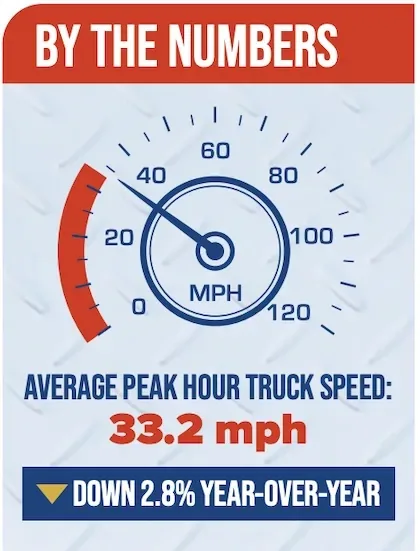
Houston’s worst, I-45 at I-69/US 59, ranks fourth nationally, with peak speeds averaging just 20.2 mph. The I-10/I-69 interchange jumped a staggering 77 positions to land at number eight, a signal that conditions there deteriorated sharply year over year.
Why is Texas so congested? The state added roughly 1.6 million residents between 2020 and 2023 alone, making it the fastest-growing state in the nation. Its major metros, Houston, Dallas-Fort Worth, Austin, and San Antonio, are all in the top ten for urban population growth, and the highway network was never designed to absorb this pace of expansion. Texas also sits at the center of NAFTA-era freight corridors, meaning the truck traffic was already heavy before the population boom intensified commuter congestion on top of it.
We navigate this every day. When the routing allows it, we avoid these corridors. When it doesn’t, we plan around peak hours and build the delay time into the schedule. That’s not a workaround; that’s just operating professionally in the state we call home.
You can see ATRI’s bottleneck map at truckingresearch.org.